7 minutes read

Salla Blog
Salla Growth Team

Practical solutions to help you market a product
Creating a great product that meets a market need can be a great achievement in the beginning, but it is only one step in a multi-mile journey where you can find a shortcut and ideal path if you can figure out the optimal way to market a product to inform your customers about it.
Salla, the future of e-commerce, is an easy platform to start your business
In how to market a product, you must express value, not features
Management consultant Peter Drucker says: ”Customers do not buy products, but the benefits those products and their suppliers offer them.” In fact, there is a vast difference between mentioning features and conveying the benefit value in how to market a product. But before that, you must keep in mind that you have spent a long time analyzing and testing your product, so your knowledge of it cannot be compared to a customer who will spend about 10 minutes with a salesperson, or who may take 5 minutes to browse your website, or will give less than 15 seconds of their time to watch an ad passing through their timeline on a social media platform. This limited time is all you have to market the value of your product, and this value is what will influence the purchase decision. So, it is important to know how to market a product, and the question now is:

How can you increase the success rate of the persuasion and purchase opportunity when marketing a product?
Direct all your focus towards (value), not features.
Speak in the language of the target customer, not yours.
Mix - early on - the marketing and sales teams in the product development process.
An example of a success story in how to market a product
The company SmugMug is an internet startup that offers photo-related cloud services; allowing users how to sell products , store, share, and sell them securely online. SmugMug offered its customers 4 subscription categories with an exaggerated number of features—over 100 features—which exceeded the comprehension of the largest segment of site visitors (the average customer). Here arises the common saying, ”Don't give too many options, you'll confuse them,” because an abundance of options usually ends in distraction, confusion, and consequently, losing the desire to subscribe and buy.

In this story, we still have a great innovation that covers a real need, but the dilemma is in how to market a product in a way that makes the beneficiary feel their need for it. Here, the founders Chris and Don MacAskill realized they were spending too much time talking about features instead of perks and benefits, so they reconsidered how to improve product positioning during the marketing phase. Simply, they identified the target segment in how to market a product; which represents the average customer who was not receiving the value message properly, then they reduced the hundred features to less than 10. They also added an extra option that explains the previous features for whoever wants to compare. Later, they increased the rate of ”simplification” until it became only 3 perfectly clear categories.
Simple benefits like ”beautiful design” and ”unlimited storage capacity” are wonderful tidings for a wide range of people. Thus, the average customer can grasp what they will get from each category. A simple step, built on precise understanding, contributed to a double-digit percentage increase in revenue and conversion, thereby showing the effectiveness of how to market a product through benefits.
Is communicating value messages difficult?
The art of expressing value is no less important than the effort spent in designing a new product name the customer will pay for. The rules of the game state that the consumer must understand the extent of their need for the new item so that they go through the trouble of acquiring it, regardless of the effort and money required. Answering (why does the customer need your product and service?) is no easy task, but it is not impossible;
as long as you arm yourself with integrating the front-line sales and marketing teams—responsible for designing and delivering the message—with the innovation team leading the product development process. In this way, it is possible to understand the value messages that resonate most with customers, helping provide valuable data for the design process of future products and activating the visual marketing of a new product according to a shared and harmonious understanding from the start.

Three unique steps to help you exceptionally express your product's value
Step One | Put the spotlight on benefits, and don't describe features
Remember that the feature is about the product, while the benefit is for the customer, and the value is a measure of the benefit the customer receives, and this is what you should consider when marketing one of your products.
Ask yourself - with every feature -: ”What will the customer get because of this feature?”
If you hesitate in how to market a product regarding your way of expressing your product's benefits, look for the problems that customers face and how your product will solve them.
Try to understand how your customers measure their performance and how your product will affect their metrics; the more you understand your customer, the more you will arrive at the messages suited to their priorities in how to market a product.
You must determine the relative value of your product, meaning the competitive value you offer them compared to what they will get from competitors.

We invite you to try the ”Matrix of Competitive Advantages,” abbreviated as MOCA, which appears as follows:
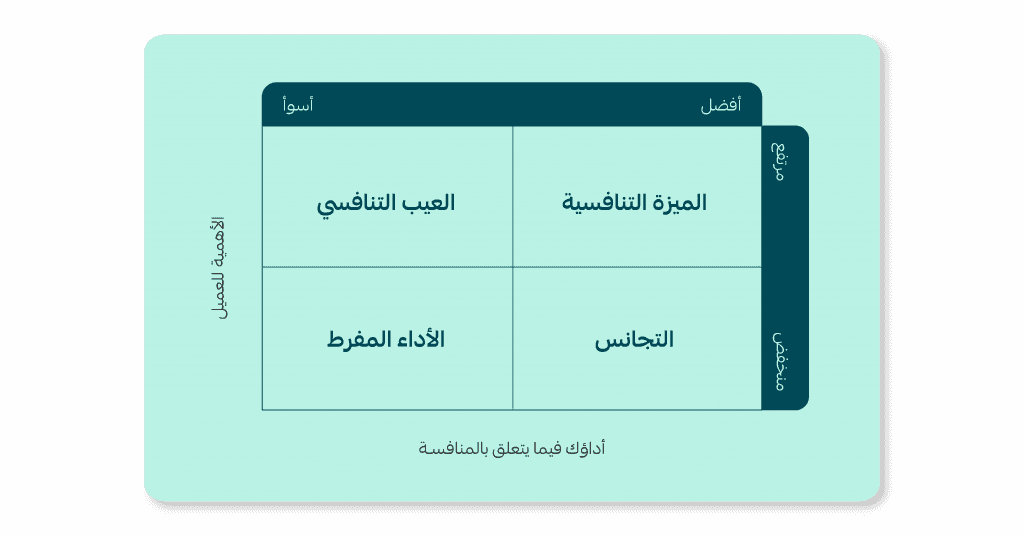
You need to look at data the way customers see it, so that the benefits your product offers—according to customer priorities—are in the upper right quadrant, which are benefits competitors cannot match and should be adopted in marketing messages in a focused manner. But of course, it won't be the only value; you will also market the benefits mentioned in the lower right quadrant, which relate to benefits you provide better than competitors but are less important to your customers, making them seem more important in their eyes. However, if you cannot prove that, you can ease off on them and focus on priorities.
How the product or service originated, and how much you spent on it, may be wonderful to you, but it doesn't matter to your customers. What actually matters to them is what they will gain from your innovation and what it will add to them.
Express your value very briefly, making it short but attractive.
Your infatuation with your product might distract you from what is most important—what matters to the customer. Self-control is necessary to focus efforts on what primarily matters to the beneficiary, not on what you and your team like about the product.
Step Two | Tailor appropriate benefits to each segment
Your customers are different, and it is highly likely that your value messages will not have the same impact on all segments, so it is good to diversify the messages—according to the need of each segment—in how to market a product.
We invite you to look at the Adobe model adobe.com as they have multiple segments and messages that match the interests and needs of each segment regarding how they market their products.
Step Three | Monitor the impact metric and keep refining your messages
Measuring your customer's perceptions of the value your messages express is extremely important in how to market a product, as through it, you know your impact and discover opportunity areas to improve direction and language. Do not fear renewal whenever you see the futility of your previous messages; instead, be ready to build a strategy aligned with current requirements and watch the numbers jump around you.
Finally; how to market a product is the cornerstone of improving profits and raising the level of dealing with customers; do not make it a secondary phase as long as it is an investment tool in the company's chain of successes.

Salla Blog
Salla Growth Team
189
50
Featured Writer

Digital Marketing
How to effectively organize a Content Calendar
Did you know that what you see on social networks from brand platforms only reaches the publishing stage after being included in a "content calendar" designed to organize content planning and its publishing mechanism? Great impact doesn't happen randomly,...
12 minutes read
Salla Blog

Digital Marketing
Steps to build a marketing plan for your online store
Are you looking to improve your marketing plan? In this article, you will find the best way to build a digital marketing plan, along with a checklist to help you build your plan step-by-step
19 minutes read
Salla Blog

Digital Marketing
My experience with Salla: Qalat Al-Takhfidat (Discount Castle) Store
Who is the owner of the Qalat Al-Takhfidat (Discount Castle) store? Engineer Ali Omar Bazaara, an IT and e-store management specialist, and consultant in the modern smart systems department at Qalat Al-Takhfidat. Salla, the future of e-commerce platform...
2 minutes read
Salla Blog

Digital Marketing
The promotional mix increases the chances of your store's success
Before we learn about the concept of the promotional mix, you must know that in the field of marketing there is no room for coincidence; even a highly magnificent product cannot sell itself automatically...
10 minutes read
Salla Blog